Unlocking India’s Care Economy: Putting Carers at the Heart of Development

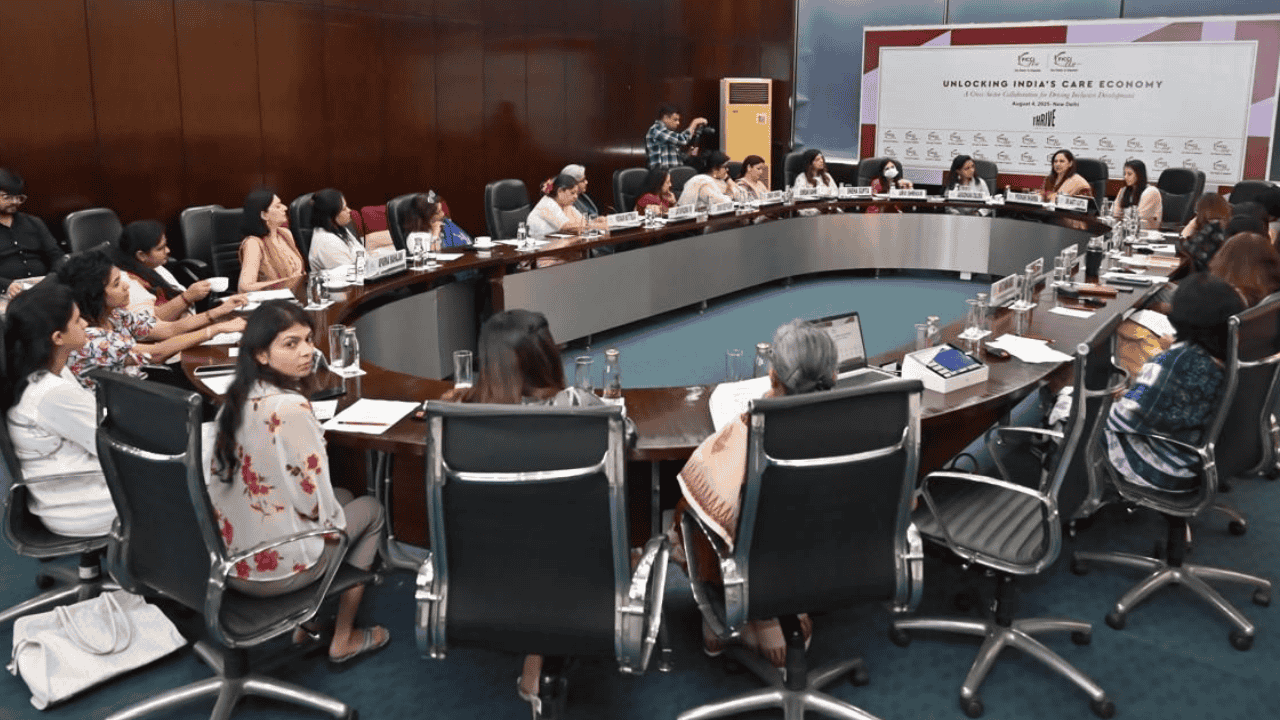
On 4 August 2025, FICCI FLO (the women’s wing of the Federation of Indian Chambers of Commerce & Industry) and YFLO Delhi (its youth wing for women under 40) brought together leaders from policy, business, health, education and civil society for a roundtable on Unlocking India’s Care Economy: A Cross-Sector Collaboration for Driving Inclusive Development.
Carers Worldwide India was proud to be represented by their trustee Aparna Mahajan, who carried the voices of unpaid carers into this important conversation.
Why the Care Economy Matters
Unpaid care is the invisible thread that holds our society together. Whether it’s caring for children, older people, or family members with illness or disability, millions of Indians provide unpaid care every single day. Yet this essential work is rarely recognised, supported, or valued.
The result? Carers - mostly women - are excluded from the economy, their health and well-being are neglected, and national statistics don’t reflect the true picture of growth and productivity.
This is why the roundtable was such an important moment. For the first time, a mainstream platform like FICCI FLO and YFLO put unpaid care work at the centre of a national policy discussion.
Aparna’s Voice at the Table
In the breakout discussions, Aparna made sure that carers’ perspectives were not lost. She spoke passionately about the need to recognise unpaid care work as part of India’s Gross Domestic Product (GDP).
Some participants initially thought that government might not consider including caregiving in GDP calculations. But Aparna argued that unless care is counted, it will continue to be invisible in policy and funding decisions and therefore should be included as a key point for recommendations to the government. Her suggestion was well received by the majority of attendees and when the key recommendations of the roundtable were shared by FICCI FLO, “Recognise Unpaid Care Work in GDP” was listed as one of the main highlights. For us at Carers Worldwide, this is a breakthrough moment.
“If we want inclusive growth, we must value the invisible. Care work is not just love and duty—it is labour, it is skill, and it is the foundation of our economy.”
Turning Awareness into Action
Aparna also pushed for creating greater awareness of existing government schemes related to caregiving. Many families, especially in rural areas, simply don’t know about the support that is already available. She suggested a national campaign, something like a Swachh Bharat Abhiyan (Clean India Mission, a country-wide campaign launched in 2014 to achieve an open defecation free India in five years) for caregiving, to create visibility, spread knowledge, and change behaviours.
This idea also found its way into the final recommendations as the call for a National Caregiving Awareness Mission.
Wider Ideas for Change
The discussions covered a wide range of ideas to build a stronger, fairer care economy in India. Some highlights included:
- Redesigning evaluations of the Integrated Child Development Services Scheme to better measure outcomes for both children and carers.
- Establishing a National Commission on Caregiving to drive reforms and coordinate government action.
- Introducing value-based learning on caregiving in schools, so boys and girls grow up seeing care as a shared responsibility.
- Using technology to connect carers with welfare schemes and real-time support.
- Building a skilled local care workforce, supported by long-term investment and partnerships.
Each of these points reinforces one truth: investing in care is not a cost. It’s a driver of inclusive development.
Why GDP Recognition is a Game-Changer
For years, Carers Worldwide has said what is now gaining traction: unpaid care work is economic work. Without it, families, communities, and indeed the entire economy would collapse.
By valuing this work in our national accounts, we not only get a clearer picture of a country’s true GDP but also create stronger evidence to push for policy change. Recognition opens the door to rights, benefits, and support for carers - something long overdue.
Carers Worldwide’s Contribution
During the roundtable discussion, Aparna informed attendees of the work being done by Carers Worldwide India and also shared details of the Carers Worldwide Model with the FICCI FLO and YFLO secretariat, showing how we are already supporting unpaid carers in India through our local charity partners. From building carers’ livelihoods, to addressing mental health, to integrating carers into local governance, we are proving that scalable solutions exist.
We have also offered to contribute more case studies and examples to FICCI FLO and YFLO as they prepare their final report. By grounding their recommendations in real-life models, we can help ensure the report influences both policymakers and business leaders.
Looking Ahead
The roundtable has set the stage for real progress. For the first time, unpaid carers are being recognised in conversations about economic growth. But this is just the beginning.
Together, we now need to:
- Push for the formal recognition of unpaid care work in India’s GDP.
- Support a National Caregiving Awareness Mission.
- Share and scale community-based models of carer support.
- Keep carers’ voices at the centre of policy and practice.
As Aparna reminded everyone in the session, “Caring is universal. Each one of us is, or will one day become, a carer, or will need care at some point in our lives. Recognising and supporting carers is not a kindness - it is an investment in our shared future.”
At Carers Worldwide, we couldn’t agree more. Carers are change-makers on whom a nation’s economy rests, and by valuing their invisible work we take a huge step towards building a more just, compassionate, prosperous and inclusive world.
